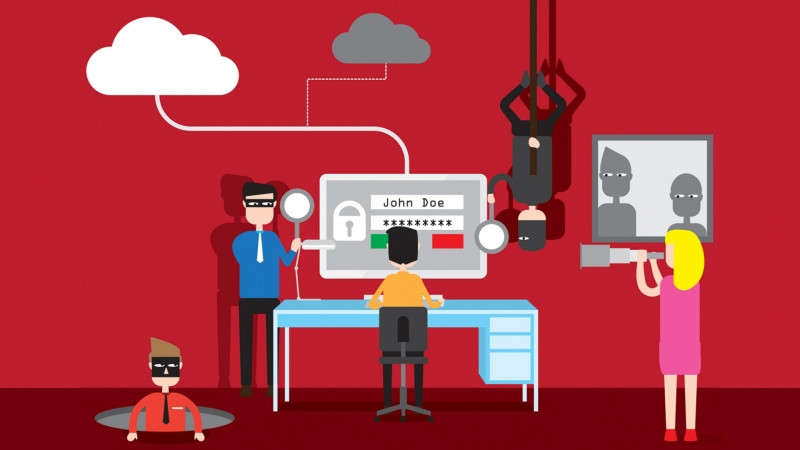
We are here talking about information security. Information security is being able to protect the data which is at the heart of what everything you do. Information security is at the heart of everything you do. There are several layers of this as you can see. Information at the very very deepest of those layers with application on top of it, host on top of that, network on top of that, and all of these combined make up your critical assets. Here's what I mean. All of the traffic that is coming in from the outside or what it's referred to as the Internet is going to come from somewhere over here. This is going to be what you refer to as your Internet source or the outside network. From that point it will enter your network. The idea is for you to be able to protect those unauthorized outside sources from entering your network, and this can represent the logical physical aspects of your information security components. From the network, that is the essential component that lets you go outside and the outside traffic come on the inside. From the network pieces you have your hosts. This is essentially your servers, your operating system, all of the components that make up your host. These can be physical or virtual in nature. And on your host you have your applications. And then within the application you have your data. So, for example, this network can be your Ethernet cables, your routers, your switches, your gateways, your firewalls, and everything in between. Everything that makes up your network is going to be sitting inside of this aspect and it is the one that is closest to, will be considered the edge device because your network would be the one that allows your edge devices, whether it be your phones, your tablets, whether it be your laptops or anything else to come in and would allow them to get out. Your host, then, your operating system would be the one that is hosting your applications. The host would be using the network to get out. So Windows uses the network to allow traffic to go out. And this going out doesn't necessarily have to be going out to the Internet. It can be going out to the LAN. Then on the host on Windows, let's say, or on Linux, let's say, you will have an application sitting, whether that be a mail server, a database server, customer relationship management system, an enterprise resource planning system, a point of sales system, really anything that is sitting on your host. That is essentially the application. Application is the one that has the data and that's where the information is. You want the people out here, I should really say, unauthorized people that are on the Internet or unauthorized devices that are on the Internet. You want them to protect. You want to protect those resources, those unauthorized resources from gaining access to your most valuable resource, and that would be your data. Now, information security utilizes some controls to accomplish that task. And these controls are both traditional and they're improved and they are categorized in the detective and the preventative categories. Detective meaning that you're going to figure out if somebody gained access to your resource within your organization coming in from the outside. If somebody came in from the outside onto your network, you want to be able to utilize these detective mechanisms to determine that they have gained access Furthermore, if at all possible, you want to prevent somebody from being able to access your devices, your network, your host or application and your data. There's something called a intrusion protection system, which you may have heard of. Also, there's something called intrusion detection systems. So they call into the category of IDS and IPS. There are many of them. I don't want to name them here, but simply put the detective mechanism of the intrusion detection systems. Try to figure out if there is some unknown entity or even if it's a known entity that is trying to gain access to the network or has gained access to the network that is a potential threat and is going to essentially get access to your data in an unauthorized way. Information security really deals with all of these components. And if you think about it just a little bit, to gain expertise in the networking side, the switches, the routers, the cables, the devices, the gateways and such, you really want to think about that. You really want to think about how to have expertise on the network, on the host, on the application and on the data itself.